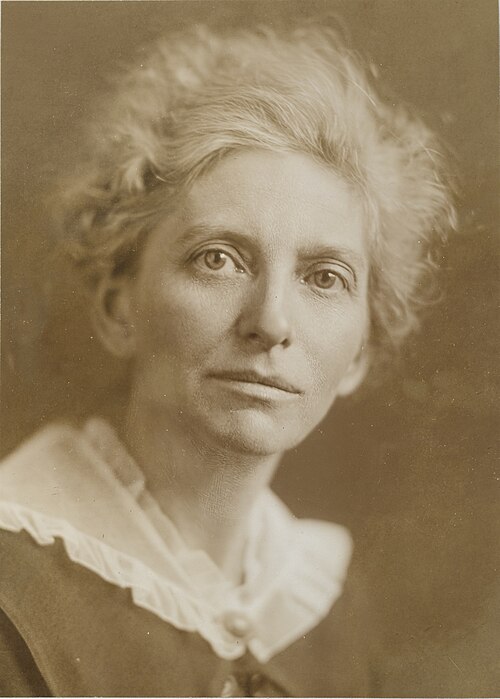
 Edith Guerrier (September 20, 1870 – November 15, 1958) was a pioneering American librarian, social reformer, and progressive leader whose life and
career profoundly shaped community welfare and library science in Boston.
Edith Guerrier (September 20, 1870 – November 15, 1958) was a pioneering American librarian, social reformer, and progressive leader whose life and
career profoundly shaped community welfare and library science in Boston.Partner Edith Brown
Queer Places:
18 Hull St, Boston, MA 02113, USA
80 Nottinghill Rd, Boston, MA 02135, USA
Oak Grove Cemetery, 185 Parker St, New Bedford, MA 02740, United States
Edith Guerrier (September 20, 1870 – November 15, 1958) was a pioneering American librarian, social reformer, and progressive leader whose life and
career profoundly shaped community welfare and library science in Boston.
Born in New Bedford, Massachusetts, to George Pearse Guerrier, an English immigrant and Civil War veteran, and Emma Louisa Ricketson Guerrier, Edith experienced a fractured childhood following her mother's early death. Because her father struggled to find steady work, she was frequently separated from him, living at times with relatives. Notably, she spent time with her mother's siblings, the Ricketsons, a family of well-to-do abolitionists, naturalists, and transcendentalists whose social circle included historical luminaries like Henry David Thoreau, Ralph Waldo Emerson, and members of the Alcott family, deeply influencing her worldview.
In 1887, her father sent her to the Vermont Methodist Seminary and Female College in Montpelier, where she graduated four years later. Moving to Boston in 1892 with aspirations of becoming an artist, she attended classes at the Museum of Fine Arts (MFA) School. To support her studies, she secured a position in the nursery of the North Bennet Street Industrial School in the North End, a densely populated immigrant center managed by philanthropist Pauline Agassiz Shaw. While at the MFA School, Guerrier met fellow student Edith Brown, who would become her lifelong personal and professional partner. Initially sharing a modest room on Massachusetts Avenue, the two women formed an enduring bond that lasted nearly four decades. Through her work in the North End, Guerrier also cultivated influential relationships with prominent Boston figures such as James and Helen Storrow, who later helped back the couple's ambitious community projects.
By 1899, Guerrier was managing the boys' and girls' reading rooms at the West End branch of the Boston Public Library. Recognizing that existing programs for girls were scarce and heavily focused on traditional domestic roles, she took the initiative to create a girls' reading club. This endeavor blossomed into the renowned Saturday Evening Girls club, which served daughters of Jewish, Eastern European, and Southern Italian immigrants who typically remained separated by cultural and linguistic barriers. The club fostered literacy, critical thinking, and community integration through storytelling, theatrical productions, lectures by Boston intellectuals, and the publication of their own newsletter, The SEG News. Building on this success, Guerrier expanded her reading clubs to serve various age groups, ultimately enrolling over 250 girls by 1915.
Inspired by European craft traditions observed during travels with Edith Brown, Guerrier helped establish the Paul Revere Pottery Club. Backed by financial support from Helen Osborne Storrow, Guerrier and Brown built a two-story workshop on Nottingham Hill in Brighton in 1915, where the Paul Revere Pottery was founded. They lived in an apartment built into the upper floors of the pottery's headquarters at 18 Hull Street in Boston's North End. The enterprise provided valuable vocational training and independent income for young immigrant women, merging artistic expression with social uplift.
In 1915, backed by philanthropist Helen Osborne Storrow, Guerrier and Brown built a two-story English-style stucco workshop and cottage on top of Nottingham Hill (later addressed as 80 Nottinghill Road) in Brighton. They lived and worked there permanently until Edith Brown's death in 1932.
Guerrier's impact extended far beyond the North End into national service. In 1917, she took a six-month leave from the library to volunteer in Washington, D.C., for Herbert Hoover's National Food Administration, where she organized information services for public libraries nationwide and launched the bulletin Food News Notes for Librarians. She subsequently championed the establishment of a National Library Service and authored the authoritative 1919 volume The Federal Executive Departments as Sources of Information for Libraries, featuring a preface by President Woodrow Wilson. Returning to the Boston Public Library, she eventually advanced to supervisor of branch libraries before being forced into retirement in 1940.
Throughout her retirement, Guerrier remained active as a volunteer librarian for the Massachusetts Committee on Public Safety and penned her autobiography, An Independent Woman, as well as a memoir of her wartime service titled We Pledged Allegiance. She shared a home with Edith Brown until Brown's death in 1932. Edith Guerrier passed away on November 15, 1958, at the age of eighty-eight, leaving behind a legacy celebrated on her gravestone as "One of the truly great."
References:
 Improper Bostonians Lesbian and Gay Histor Paperback – January 1, 1998 by The History Project |
Other references:
Support this project
This website is a passion project researched, developed, and funded entirely by me. If you find the content valuable and would like to help support the ongoing research and hosting costs, any contribution is deeply appreciated.
Thank you for keeping this independent resource alive!
My books on Amazon: Elisa Rolle's books